
Decoding Keywords
...it assembles two Contraptions instead.

If you ask card game players “What’s the point of keywords?” the most common answer that you’ll get is “They make card text shorter”. While it is not a wrong answer, by any means, it immediately runs at mach speed against a very obvious question:
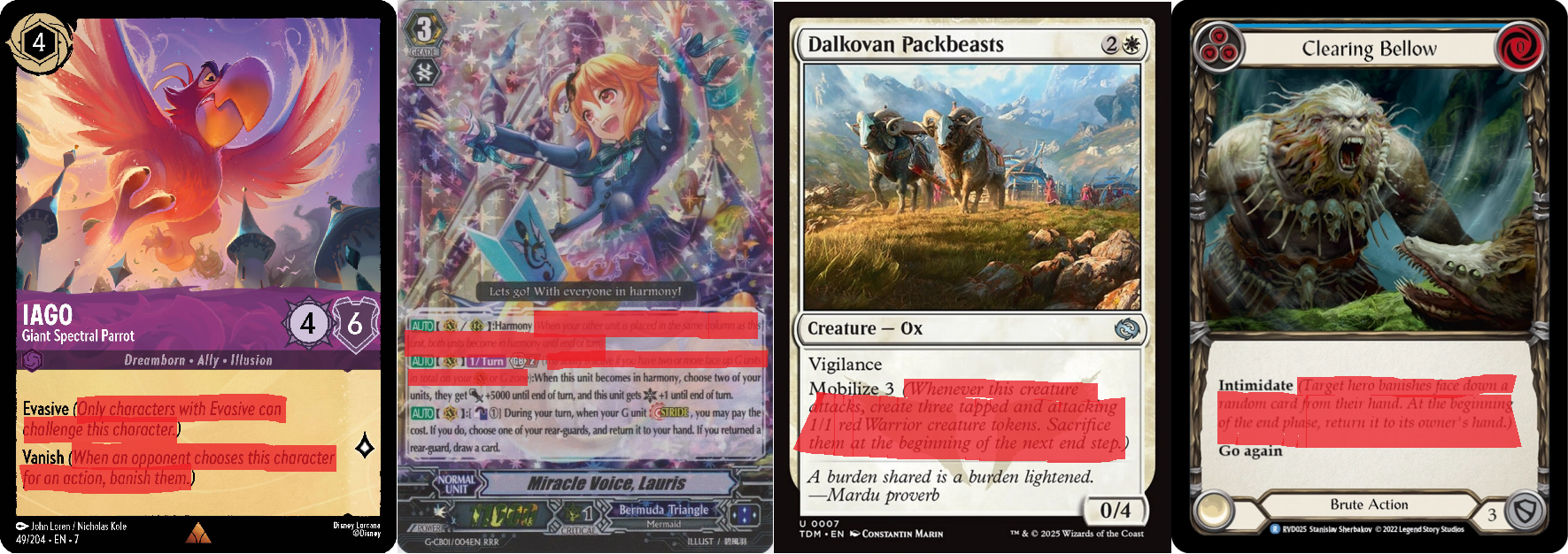
What’s with all the reminder text?
If keywords are all about reducing the amount of text on cards, and only about that, then reminder text makes no sense to include. Ever. It has the actual opposite effect of its alleged purpose: it clearly takes more characters to write the keyword plus the explanation of the keyword than it would to just write the effect on its own. And responding with “Well, we get to dump all the reminder text on the simpler cards so players can absorb it that way, and we can skip it on the more complicated cards so we can fit more effects on those” is plausible but unconvincing. Firstly, complaints about “There’s too much text on cards” aren’t really about singular outliers with a lot of text, they are more about the cumulative effect of having to read a lot of words for every card that you come across, so it would still make the situation worse. And secondly, it’s not that hard to find examples of really wordy cards where they still decided to include the full reminder text of the keywords they used.
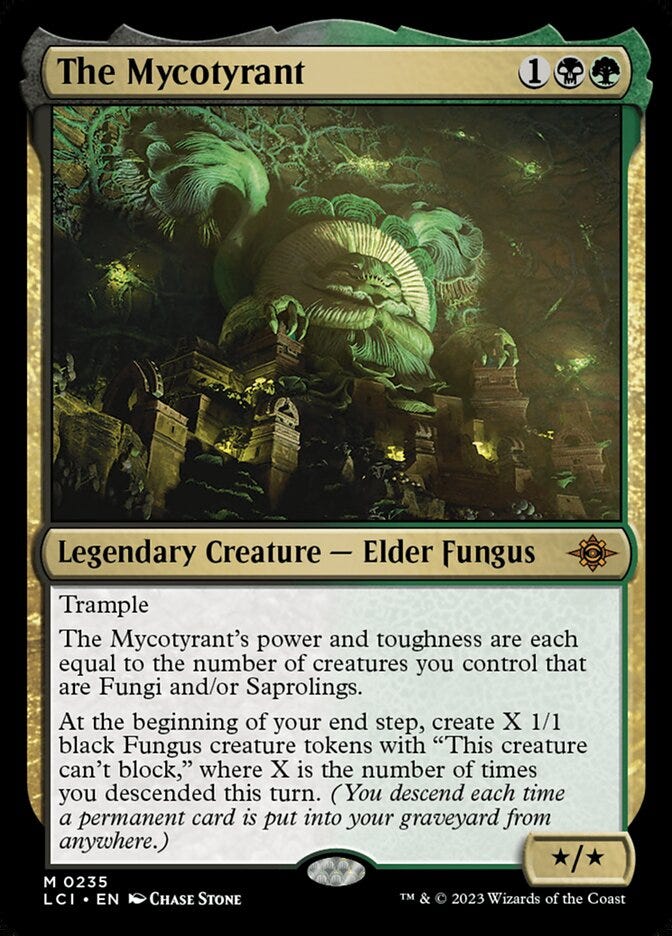
Well, there’s got to be something more to it, otherwise hundreds of editors across dozens of games through the years would have to have been acting in a blatantly irrational manner this whole time and we just let them. And luckily for us, there is more to it. Come with me.
Evergreen keywords are a window into what the designers think are their most valuable tools
When they don’t have an enfranchised friend by their side to guide them, most people will learn to play a new card game by buying some sort of introductory product and reading through the featured beginner guide. Most of those guides will also feature a brief legend of the keywords you’ll find in that intro deck, and that brief explanation is already doing a lot of work on its own in getting people to understand what the game they are going to play is like.
An evergreen keyword is a keyword that we could consider as being part of the basic lexicon of the game: they are generally really simple, they usually don’t need reminder text, and the designers will make indiscriminate use of them across many sets without thinking too much about it. If you look at the list of evergreen keywords for Magic: the Gathering, one thing should jump to mind right away: almost all of them are either directly or tangentially about combat. Even before playing a single game, before having the opportunity to develop any useful heuristic whatsoever, you are already learning that these tools, that the designers consider useful enough to make abundant use in every single set, all relate to getting into the red zone, and the centrality that that will have compared to other aspects of the game. The fact that Lorcana decided to canonize Rush, a keyword that allows you to attack immediately but doesn’t let you score points until later, is telling you something about the expected value and the intended availability that the developers wanted for those two aspects of the game. Go again being one of the first things you learn about Flesh and Blood sends a message regarding the relative frequency of decks that get to play lots of attacks compared to decks that just clobber you with one big hit each turn.
They make cards easier to read
There’s a lot of information to be processed in any given match of a TCG, so it’s important to make sure that navigating the text of a card doesn’t take too much time and is a smooth process. Relegating each effect to a discrete paragraph helps a lot on that front, where once you start reading an effect and you know it’s not the thing you are looking for you know where to skip to and check next, and keywords accelerate that process.
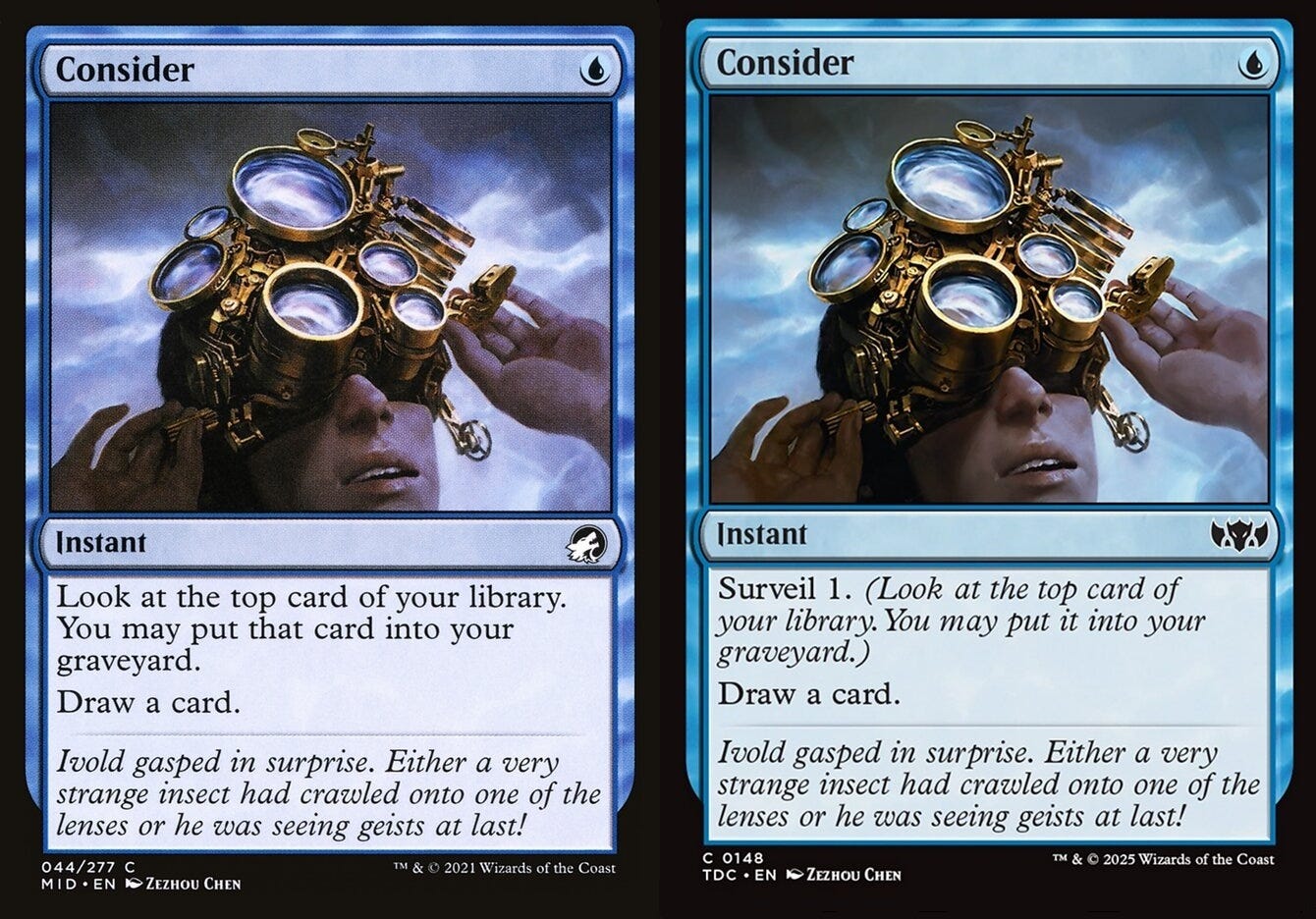
Compare these two, functionally equivalent printings of Consider. The post-errata one presents you with a block of reminder text in a different typography. As soon as you reach the first parenthesis, the card is telling you “You are supposed to know how this works, if you don’t know here’s us spelling it out. If you do know, then this skippable block of text is clearly different from the text you care about, so it’s easier to jump over”.
They indicates the themes of the set or of the faction they are featured in
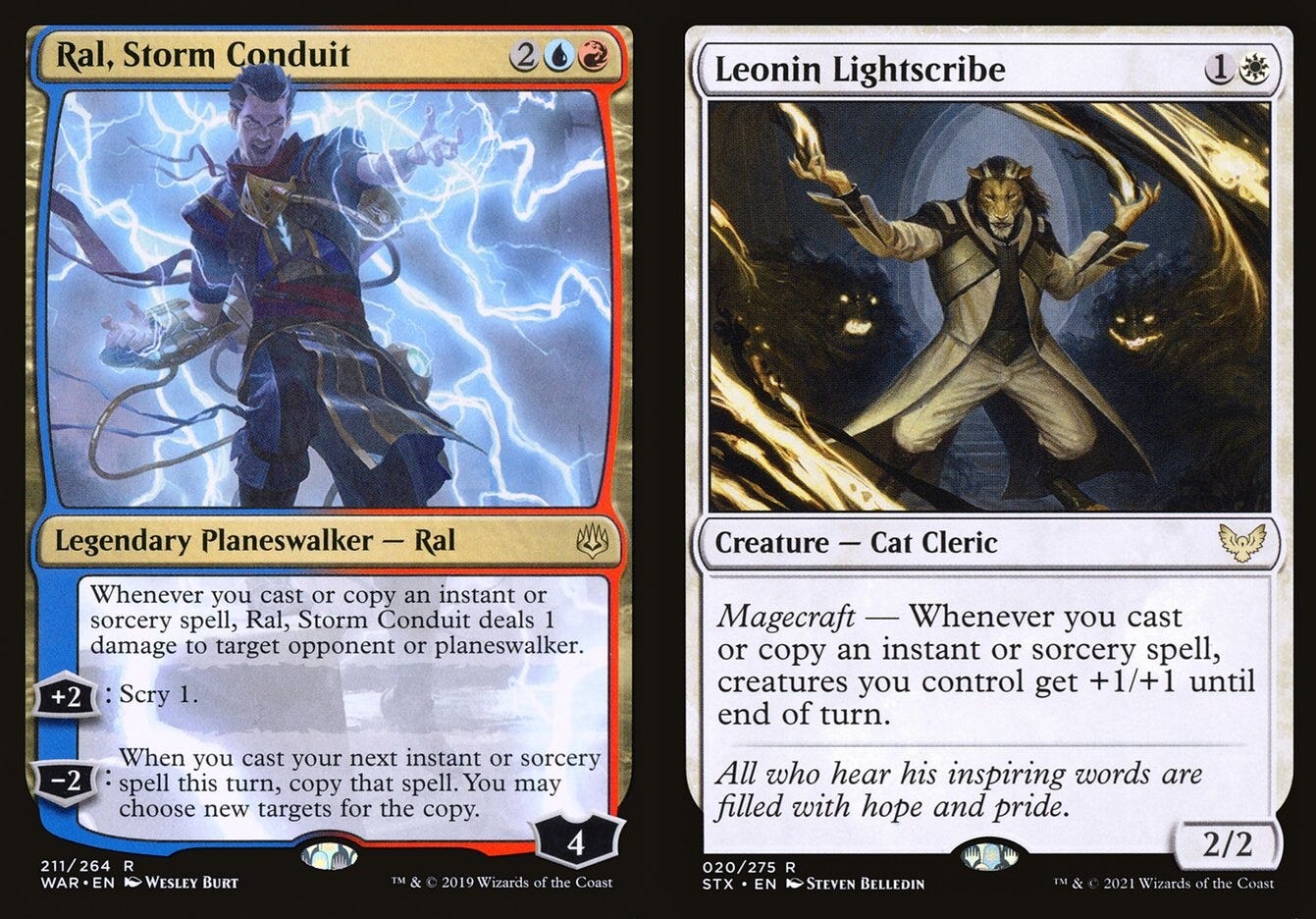
Similarly to how evergreen keywords can guide you to the things that are important about the game, set-specific keywords can teach you things about the expansion even without getting to look at all the cards. This might require a bit of a change of paradigm if you are used to thinking about TCG sets as a collection of 100 or so cool cards in various degrees of being pushed for competitive play, but that’s not really the case. Designers have an interest in making it so that if you open a pack and you see a cool card you like, that there’s going to be decent odds that it’s going to have some synergy with other cards that you just opened. Keywords allow you to make the jump where you get to indicate to the players whether we are talking about “This is a cool card with some incidental synergy pieces sprinkled in the set” or about “This is a theme of the set, there’s a lot of cool stuff similar to or that cares about the same stuff as this in this in this expansion”. A keyword can then become a bright red arrow that says “This is something that we care about now. If you care about this, we have created the tools to make this work”
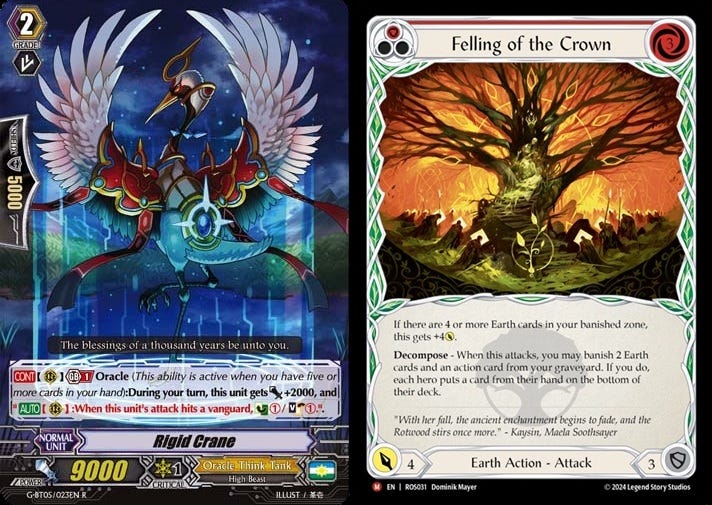
Going beyond just a single set, an analogous line of reasoning is found when we are designing for in-lore factions. In a game like Vanguard where each faction gets its own keywords that are locked to it, they are excellent shortcut that get at “This is how these guys play, this is what they care about, this is why you’d like them”. Additionally you can create some interesting lore moments by breaking the script and featuring the same keyword on an out-of-faction card. Much room to explore there.
Once a keyword is part of the game other effects get to care about it
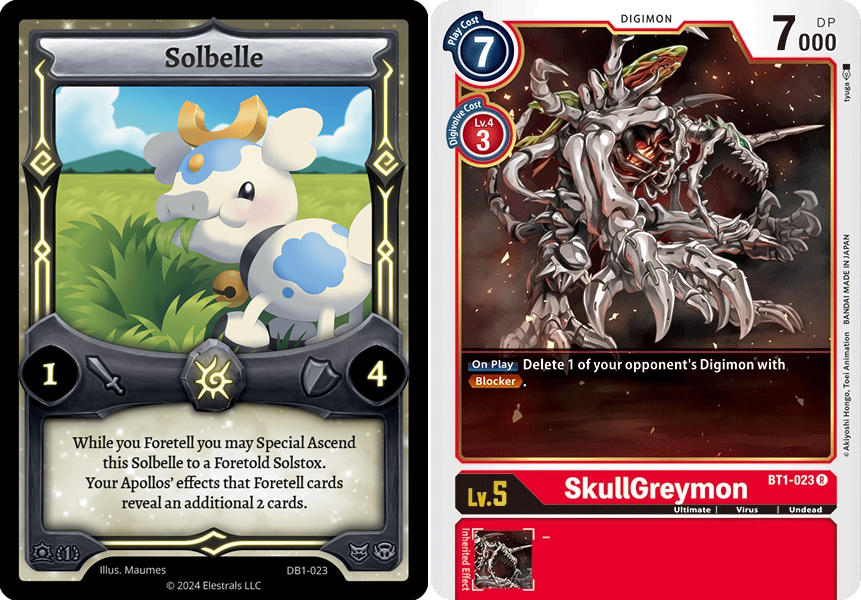
Just having keywords in the game can introduce some novel interactions that would otherwise not be available. It’s usually bothersome to have to be like “If an effect would do [such and such thing], instead [another thing happens instead]”, but doing the same trick with keywords is much more immediate. More simply, we can just create effects that check whether other cards have a certain keyword, so we can restrict some particular card to only working with a much more specific category of cards that’s not necessarily exhausted by other descriptions. And in the cases we mentioned above where a keyword is strongly associated with a particular faction, then some card either directly hating on or directly helping that keyword can have some strong flavor implications.
Flying is considered the Magic keyword: it’s simple, it’s intuitive, it plays well. It would also be way less elegant to implement without keywording, since it uses a perverted trick of self-reference and talks about itself in its own explanation.
They can hide complexity away
I told a bit of a fib earlier when I said that writing out the keyword and the reminder text for the keyword would always take more space than just spelling out what the effect does: famously reminder text only needs to be broadly indicative of what an effect does and doesn’t need the same rigor that goes into regular text. As such, there’s a lot of effects that are actually really complex but can be easily summarized in a way that gets you 90% of the way there, and those are perfect candidates for keywording. Trample in Magic is a solid example of this: it’s a keyword that, both historically and contemporaneously, is just bursting with unintuitive scenarios and odd interactions, and would be extremely tedious to spell out in regular rules text. However, you can also say “(This creature can deal excess combat damage to the player it’s attacking)” and most people won’t need any more elaboration than that, you get to stove all those unsightly details away in the rulebook.